Self-Improvement, Self-Confidence, confidence, lifestlyle, lessons, positive psychology

A Foolproof Plan to Boost Your Confidence

We have the power to imagine a better world

Do you feel like you could benefit from strengthening your confidence? While it’s not 100% imperative to have confidence, it certainly makes life a lot easier.

You can still accomplish things without self-confidence, but would you actually try? If you don’t believe you’re going to be successful, you’ll likely throw in the towel before getting very far. Confidence can be elusive as our success ebbs and wanes.

How can you maintain your confidence through the ups and downs of life?

Try these tips. They’ll raise your self-confidence through the roof:

  1. Know thyself. Make a list of all of your strengths and capabilities. Include things that you seem to have a talent for but have never actually tried. Perhaps you’re reliable, intelligent, coordinated, and have excellent musical abilities. A great way to get to know who you really are is to have your astrology chart done. An Energy-Balance ‘Who Am I?’ report will reveal your potential based on the way the stars were aligned at your birth!
  • Putting your positive qualities on paper will show you the many reasons you have to be self-confident. You’re already doing better than you think.
  1. List your major achievements. Think about all the amazing things you’ve already accomplished. We tend to mentally linger on our perceived failures. Try lingering on the good stuff for a change. We can choose our thoughts, so choose wisely.
  2. Make a list of your daily accomplishments. At the end of each day, make a list of all the things you accomplished.
  • Maybe you remembered to take the trash to the curb, pay all your bills on time, exercised for 30 minutes, and helped your child fix her bike.
  • It might sound trivial, but each of these little things matter.
  1. Learn how to motivate yourself. Real, justified confidence comes from the ability to achieve goals. Achieving goals largely comes from the ability to stay motivated.
  • We all know it’s easier to put things off, procrastinate, and invent excuses for not applying ourselves.
  • Set yourself up to be successful each day. Come up with a few daily activities that will improve your life and also provide a sense of accomplishment.
  • For example, you might decide to read a certain number of pages in a book each night or exercise for 45 minutes each morning.
  • Stick with your plan and you’ll begin to trust yourself to follow through.
  1. Take good care of yourself. Looking and feeling your best can contribute to your self-confidence. Take the time to stay healthy and fit. Dress well and practice good grooming habits.
  • If you take good care of yourself, you’ll start to believe you deserve it. And others will believe you deserve it, too. That’s great for your confidence level!
  1. Set goals to boost your confidence. Setting goals is important. It allows you to see what areas of your life require the most confidence. If you have the goal of finding your perfect life partner, you might require more confidence than when it comes to introducing yourself to others.
  2. Challenge your mind on a regular basis. Continue learning new things and keep your mind sharp. Everyone around you will find you interesting.
  • Consider reading, doing brain puzzles, staying on top of current events, improving your vocabulary, and playing games that require a lot of thought.
  1. Work at it every day. Work to complete these simple steps continuously. Strive to better yourself in all of these areas each day.
  • Self-confidence is not a one-time event. It has to be cultivated over time. Growing your self-confidence is not much different from growing vegetables in a garden.

Having a high level of confidence makes life so much more enjoyable. By executing a simple action plan, increasing your confidence can be fun and interesting.

Consider drawing up your own personalised self-confidence action plan. It can be incredibly rewarding. By taking charge of your life, you’ll boost your confidence even higher.
Dr Candace Pert: “We are hard-wired to be in bliss. It’s normal and it’s natural.”

Joshua Freedman of Six Seconds, the Emotional Intelligence Network, interviewed Dr Candace Pert for his article, The Physics of Emotion: Candace Pert on Feeling Go(o)d, 

Dr Pert explained that emotions are not simply chemicals in the brain – they are electrochemical signals that affect the chemistry and electricity of every cell in the body. The body’s electrical state is modulated by emotions, changing the world within the body. In turn, Pert finds emotional states affect the world outside the body.

Because of her work on emotions, Dr Pert was featured in the film, What the Bleep Do We Know, and frequently speaks on the role of emotions in the mind-body. Pert’s work helped shift the paradigm from “emotions as neuroscience” to “emotions as biology.” In her book, Everything You Need to Know to Feel Go(o)d, she’s taking the science of feeling a step further to present “emotions as physics.”

Dr Pert explains how emotions have such a powerful effect. “We’re not just little hunks of meat. We’re vibrating like a tuning fork — we send out a vibration to other people. We broadcast and receive. Thus the emotions orchestrate the interactions among all our organs and systems to control that.”

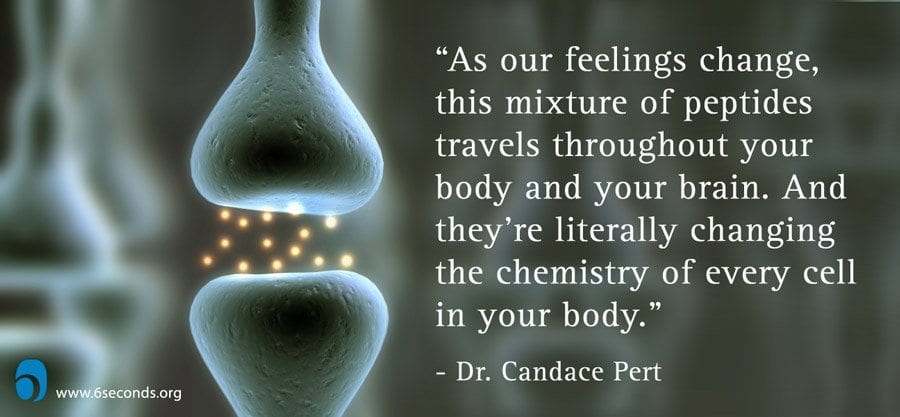
As Dr Pert explained in her earlier book, Molecules of Emotion, neurotransmitters called peptides carry emotional messages. “As our feelings change, this mixture of peptides travels throughout your body and your brain. And they’re literally changing the chemistry of every cell in your body.” Neurotransmitters are chemicals, but they carry an electrical charge. The electrical signals in our brains and bodies affect the way cells interact and function.

You have receptors on every cell in your body. They actually are little mini electrical pumps.” When the receptor is activated by a matching “molecule of emotion” the receptor passes a charge into the cell changing the cell’s electrical frequency as well as its chemistry.

Pert says that just as our individual cells carry an electrical charge, so does the body as a whole. Like an electromagnet generating a field, Pert says that people have a positive charge above their heads and a negative charge below. “So we’re actually sending out various electrical signals – vibrations.”

“We’re all familiar with one kind of vibration: When we talk, we send a vibration through the air that someone else perceives as sound. As I explain in the book, we’re also sending out other kinds of vibrations. It’s a basic law of physics that when you are close to an energy source it has a greater effect and that diminishes as you move further away. But when you are far away there is no effect.”

“It’s not something you can say in 25 words or less. It is a whole new paradigm shift that basically leads you to realise you’re not alone. You are connected to everybody else. Your emotions are key. And you are leaving a wake, changing the world around you in a huge way.”

“Blessing and bliss come from the same root. We are hard-wired to be in bliss. It’s normal and it’s natural. There is a straight evolutionary argument for this function — any creature that could not experience bliss would have just died and become extinct 200 million years ago.”

We are hard-wired to be in bliss. It’s normal and it’s natural.

The “bliss response” is closely connected to Pert’s original work on the opiate receptor. Just as the receptors for other neuropeptides trigger a cellular response, opiate receptors pick up the presence of a neurotransmitter for euphoria. The naturally occurring “bliss chemicals” are called endorphins, and they are released in the brain and body in response to emotional states and physical activities (including exercise and nursing).

The prefrontal cortex is responsible for complex, evaluative decisions. This part of the brain is loaded with opiate receptors – so structurally, our most sophisticated reasoning is linked to bliss.

Pert says the way endorphins work is evidence of bliss as an evolutionary necessity. “That’s why endorphins are such highly conserved molecules. It’s the same in simple one-celled creatures and in humans. In the new book, I talk about the evolution of the opiate receptor and how it’s in our frontal cortex, the most advanced part of our brains.”

“It’s like we’re designed to make choices around pleasure. The very highest, most intelligent part of our brain is drenched in receptors to make us use pleasure as a criterion for our decisions. So it’s okay to feel good – God is good.”

While it’s clear that the “bliss receptors” are centred in the prefrontal cortex, the part of the brain that makes evaluative and complex decisions, there isn’t a clear reason.

“Scientists can never ask why. They can only ask ‘what’ and ‘how.’ But we know that the vibration in these receptors mediates, or leads, to the whole organism feeling bliss. And then I talk in the book about how that endorphin vibration is really the bliss of union and divine union.”

So when we create that kind of resonance internally, we are in line with that divine self. True bliss represents an optimal state of functioning. “This state is the natural function, but our society interferes. You don’t have to teach this to native peoples. Most of us have lost touch with that reality. Most of us seem to be locked in a grim struggle constantly rushing off to the next thing. So while it may be natural to be in bliss, we have to learn again to feel our natural state of bliss, to feel the spiritual nature of everything around us, every moment. This doesn’t have to do with church. It doesn’t have to do with whether you were bad or good. It’s about feeling good.”

A full copy of this report can be found here.

What’s the difference between and Emotions, Feelings and Moods?

Joshua Freedman of Six Seconds, the Emotional Intelligence Network, says the simple answer is time.

Emotions are chemicals released in response to our interpretation of a specific trigger.  It takes our brains about 1/4 second to identify the trigger, and about another 1/4 second to produce the chemicals.  By the way, emotion chemicals are released throughout our bodies, not just in our brains, and they form a kind of feedback loop between our brains & bodies.  They last for about six seconds.

Feelings happen as we begin to integrate the emotion, to think about it, to “let it soak in.”  In English, we use “feel” for both physical and emotional sensation — we can say we physically feel cold, but we can also emotionally feel cold.  This is a clue to the meaning of “feeling,” it’s something we sense.  Feelings are more “cognitively saturated” as the emotion chemicals are processed in our brains & bodies. Feelings are often fueled by a mix of emotions, and last for longer than emotions.

Moods are more generalised.  They’re not tied to a specific incident, but a collection of inputs.  Mood is heavily influenced by our environment (weather, lighting, color, people around us), by our physiology (what we’ve been eating, how we’ve been exercising, if we have a cold or not, how well we slept), by our thinking (where we’re focusing attention), and by our current emotions.  Moods can last minutes, hours, probably even days.


AromaTouch Technique

What is the AromaTouch™ Technique?

7[1]dōTERRA’s AromaTouch Technique is a clinical approach to applying essential oils along energy meridians and visceral contact points of the back and feet to help balance sympathetic and parasympathetic nervous systems of the body. Developed by Dr. David Hill, a leading expert in integrative medicine and therapeutic applications of essential oils, the AromaTouch Technique improves wellbeing by reducing physical and emotional stressors and by supporting healthy autonomic function. The technique is simple and intuitive and uses dōTERRA’s CPTG Certified Pure Therapeutic Grade™ essential oils for an unparalleled grounding experience for recipients.

AromaTouch™ Procedure

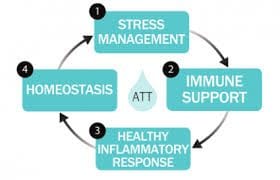
The AromaTouch Technique includes four primary steps designed to minimise systemic stressors to autonomic balance.

Each step includes the application of two essential oils or essential oil blends specifically formulated to support healthy emotional and physiological functions for wellbeing. The technique requires 30 minutes per application, and multiple applications can be serviced with one set of dōTERRA’s essential oils.      Homeostasis


AromaTouch™ Hand Technique

An AromaTouch™ Hand Technique massage provides rapid stress reduction and a beautiful introduction to aromatherapy.

A light hand massage can promote healing and relaxation throughout the body’s system without being too vigorous. Pressure points on the hand have physiological correspondences to the rest of the body, and there are also nerve receptors here that send messages of relaxation to the brain.

Typically AromaTouch™ Hand Technique is quick, relaxing and provides you with immediate health benefits, such as improved finger and wrist range of motion and enhanced circulation in your hand muscles.